






How we created 19 mini-games for Scholastic in just 2 years
We designed and developed amazing mini-games for brands such as Dog Man, Captain Underpants, The Baby-Sitters Club and many more.
Thinking about porting your game to Unity? Learn how AI-assisted migration reduces risk, preserves gameplay and unlocks new platforms.

If your game has been successful, the last thing you want is for it to become limited by ageing technology.
Whether your game was built using Objective-C, Objective-C++, C++, Java, Kotlin, Swift, ActionScript, XNA, MonoGame, a proprietary engine or an older version of Unity, modernising it can unlock entirely new opportunities. By migrating to Unity, you can release on new platforms, improve maintainability, introduce modern features and extend the commercial life of your product.
Today, advances in AI are making game porting faster and more efficient than ever before. At Mode Games, we combine AI-assisted development with experienced Unity engineers to analyse, migrate and validate legacy code while preserving the gameplay that made your game successful in the first place.
Rather than simply translating one programming language into another, our goal is to create a modern Unity project that faithfully recreates the original experience while preparing it for future growth.
In most cases, yes!
Games developed over the past several decades can often be successfully migrated to Unity, regardless of the original engine or programming language. Every project is different, but if you have access to the source code and game assets, there is usually a clear path to modernising the project.
We regularly assess games built using technologies such as:
Many businesses assume an older game needs to be completely rebuilt from scratch. In reality, much of the existing gameplay, artwork, audio and game logic can often be reused or adapted, reducing both development time and cost.
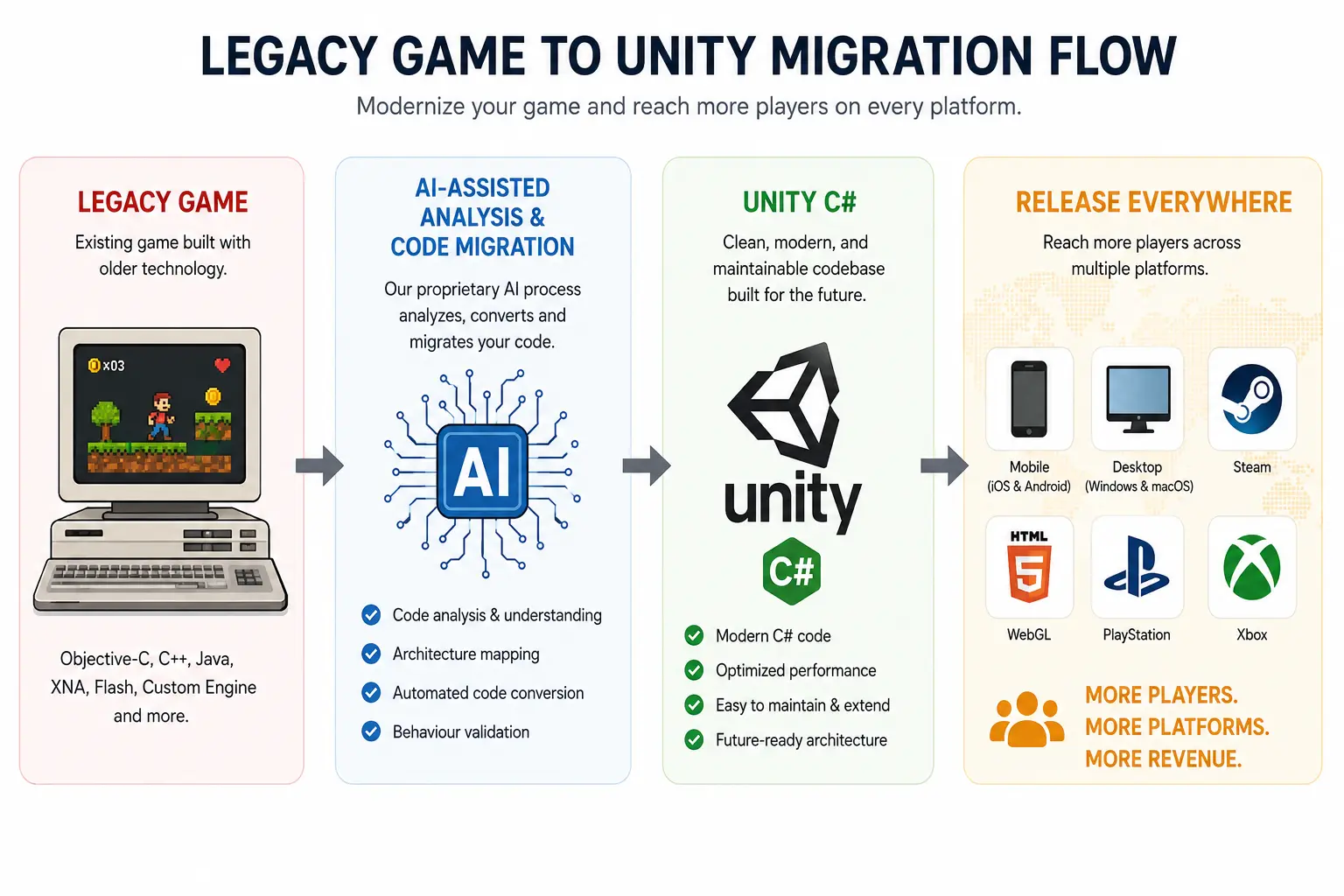
If your game already has proven gameplay, existing users or valuable intellectual property, rebuilding everything from the ground up is rarely the most cost-effective option.
A Unity migration allows you to retain the value you've already created while taking advantage of modern development tools and platforms.
Some of the biggest benefits include:
Most importantly, your game has already proven itself. Porting builds on that success instead of starting again.
Technology continues to evolve. Operating systems change, hardware improves and older development tools eventually become unsupported.
Porting your game to Unity provides a modern, actively supported platform that makes future development significantly easier.
Future-proofing your game can provide benefits such as:
Rather than allowing your game to become tied to ageing technology, a Unity migration creates a solid foundation that can continue evolving for many years.
Absolutely!
Artificial Intelligence has dramatically improved the efficiency of software modernisation. While AI doesn't replace experienced developers, it can automate many of the repetitive and time-consuming tasks involved in analysing and migrating legacy software.
At Mode Games, we use AI as an engineering tool to help accelerate game migration while ensuring quality remains our highest priority.
AI can assist with:
Every AI-generated solution is reviewed, refined and tested by experienced Unity developers before becoming part of the final product.
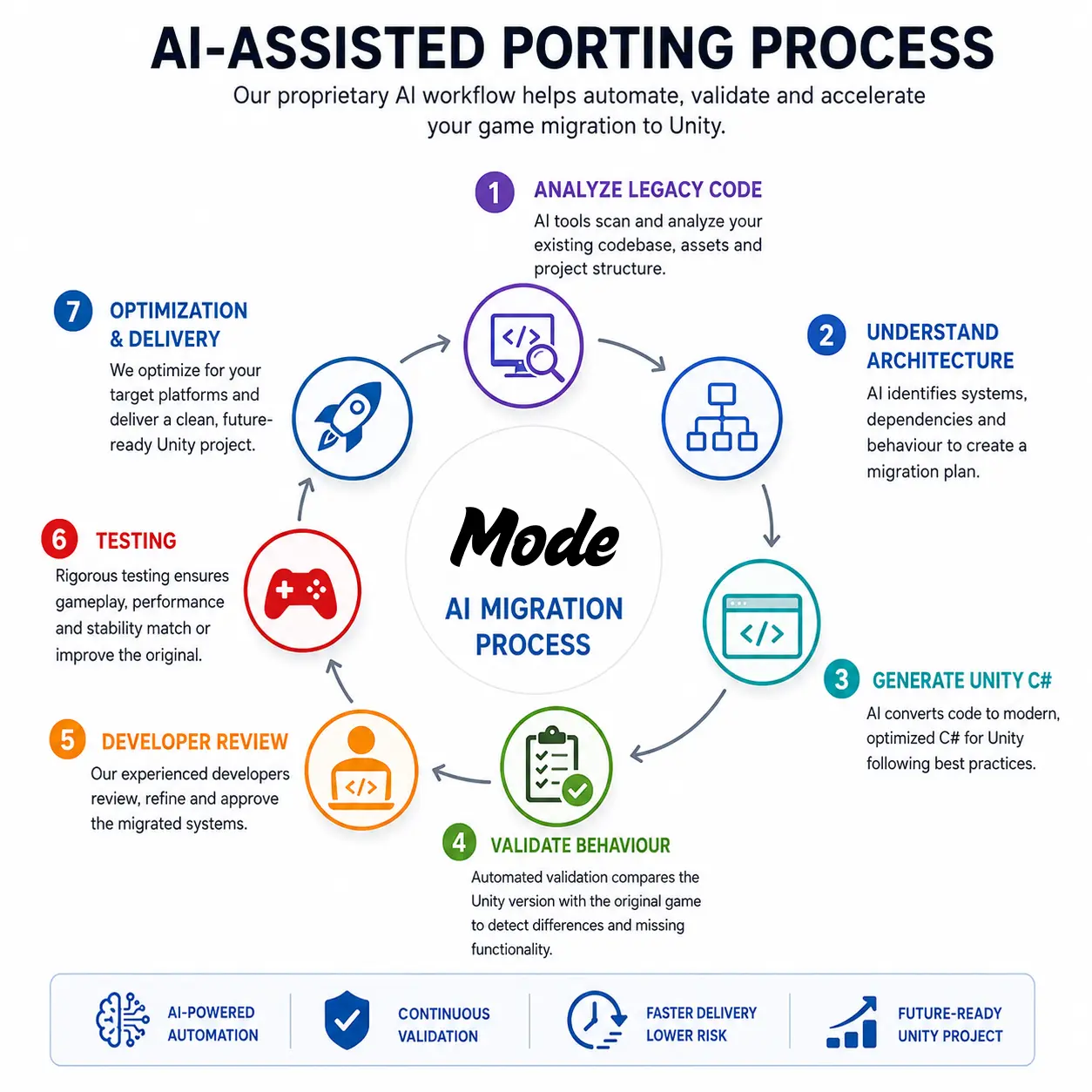
Over years of working with Unity and modern AI tools, we've developed an AI-assisted migration workflow that helps modernise games far more efficiently than traditional manual approaches.
Rather than asking AI to "rewrite the game", we use structured prompts, automated analysis and validation techniques to progressively understand, convert and verify legacy systems.
Our workflow helps us:
This approach allows our developers to spend more time solving complex engineering problems and less time manually rewriting repetitive code.
For most clients, this is the single most important question.
Players don't care what programming language a game uses—they care that it feels the same.
One of the biggest risks during any migration is unintentionally changing gameplay behaviour.
Small differences in calculations can affect:
Our migration process is specifically designed to minimise these risks.
Rather than simply converting code line by line, we compare systems, validate gameplay behaviour and continually test the Unity implementation against the original game.
AI also assists by helping identify behavioural differences, highlighting areas that require closer review and supporting regression testing throughout the project.
The result is a Unity version that preserves the gameplay players already enjoy while benefiting from a modern, maintainable codebase.
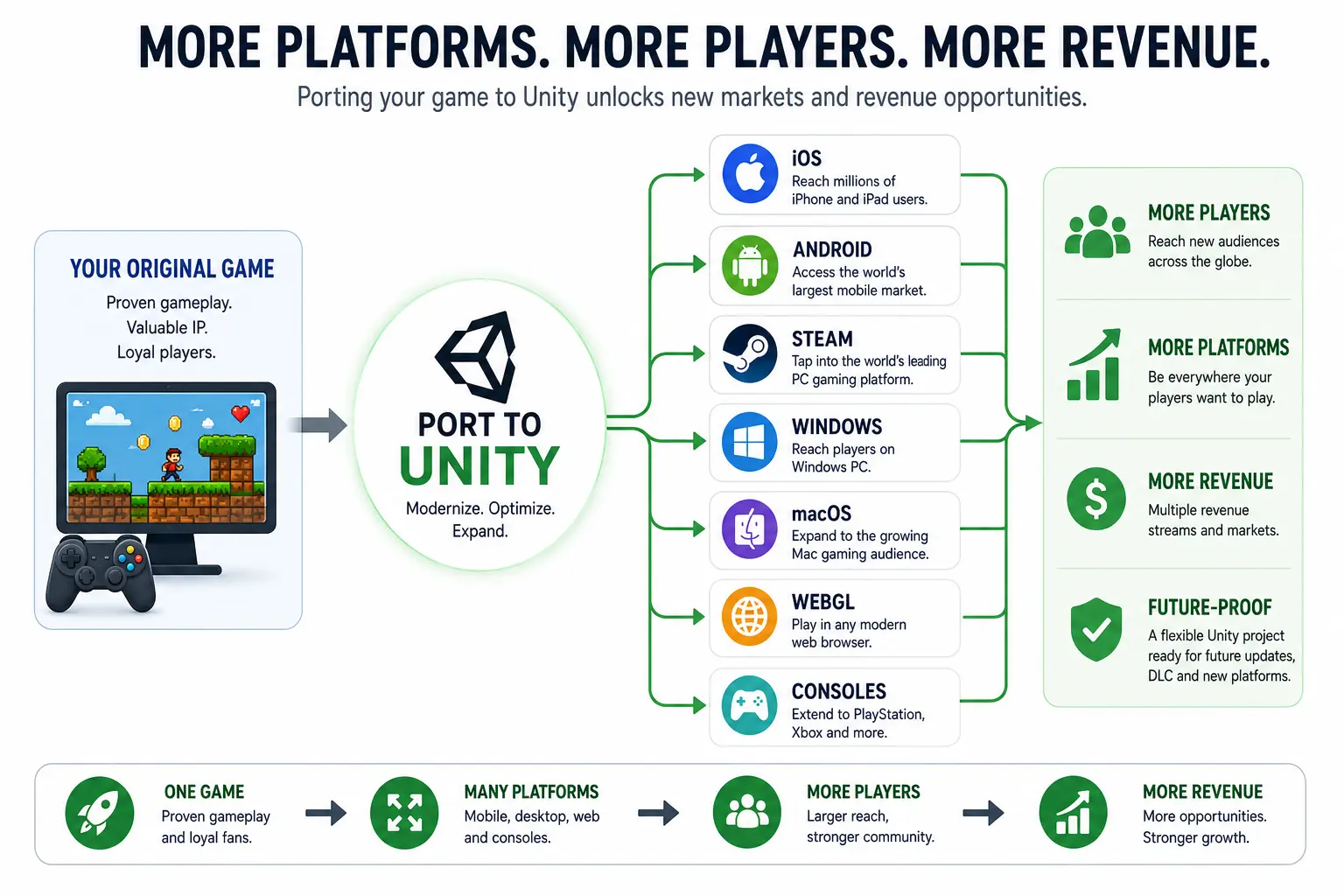
Porting your game isn't simply a technical upgrade, it's an opportunity to unlock new revenue streams.
Many successful games were originally released on a single platform. By migrating to Unity, those same games can often reach significantly larger audiences. Learn more about our Unity Game Developer Services.
Additional revenue opportunities may include:
For many established games, the combination of new platforms, modern monetisation and lower ongoing development costs provides a strong return on investment.
Whether your goal is to revive a classic title, modernise a successful educational game or expand an existing commercial product, porting to Unity can help maximise the value of the investment you've already made while preparing your game for continued success.
Learn more about game development with experts.
Here are some of the most common questions that we get asked from our customers
AI is an incredibly powerful development tool, but successful game migration still requires experienced Unity engineers. At Mode Games, we automate the use of Open AI APIs (think ChatGpt) and other AI-assisted workflows to analyse legacy code, understand complex architecture, generate initial C# implementations, identify repetitive patterns and assist with validation. Every system is then reviewed, refined and thoroughly tested by our expert developers to ensure it meets production-quality standards. The result is a faster, more efficient migration process without compromising quality.
Absolutely. C++ remains common in older games and proprietary engines. We analyse the existing architecture, identify reusable gameplay systems and progressively migrate them into Unity using modern C#. AI-assisted analysis helps accelerate this process by documenting complex systems and generating initial implementations that our developers validate and refine throughout the project.
In many cases, yes. Existing artwork, animations, audio, fonts and other assets can often be reused or enhanced during the migration process. Reusing quality assets reduces development time and cost while helping preserve the visual identity of the original game. Where assets require updating for modern resolutions or hardware, we can modernise them without losing the original style.
In most cases, yes. Games developed using Objective-C, Objective-C++, C++, Java, Kotlin, Swift, ActionScript, XNA, MonoGame and many proprietary engines can be successfully migrated to Unity. The exact approach depends on the quality of the existing codebase, available assets and the platforms you want to support. During our initial assessment, we review your project to determine which systems can be reused, which should be modernised and how AI-assisted tools can accelerate the migration while maintaining the gameplay your players already know and enjoy.
Yes. Porting is often the ideal opportunity to introduce new functionality. Clients commonly choose to add cloud saves, achievements, analytics, accessibility improvements, multiplayer features, updated user interfaces, AI-powered systems, modern monetisation and improved graphics as part of the migration. Because the game is already being modernised, adding carefully planned improvements is often more efficient than implementing them later.
Yes. Many older iOS games were originally developed using Swift, Objective-C or Objective-C++. These projects can often be successfully migrated to Unity, allowing them to benefit from a modern C# codebase while expanding beyond iOS to Android, desktop, web and additional platforms. Our migration process focuses on preserving gameplay while reducing the complexity of maintaining legacy Objective-C applications.
The first step is a technical assessment. We'll review your existing game, source code, assets and business objectives to determine the most effective migration strategy. From there, we'll identify opportunities to modernise the project, reduce future maintenance costs, expand to new platforms and increase revenue while preserving the gameplay that made your game successful. Whether you're planning a full migration or simply exploring your options, we're happy to discuss your project and recommend the best path forward.
We've developed an AI-assisted workflow that combines automated code analysis with experienced software engineering. AI helps us understand legacy codebases, document systems, convert repetitive logic, generate C# implementations and compare migrated systems with the original behaviour. This allows our developers to spend more time solving complex engineering problems and ensuring the finished Unity project is maintainable, scalable and ready for future development.
The timeline depends on the complexity of the project. Smaller games may take only a few months, while larger commercial titles can require a staged migration over a longer period. Our AI-assisted workflow helps accelerate code analysis, documentation and repetitive development tasks, allowing our team to focus on implementation, optimisation and testing. During planning, we'll provide an estimated timeline tailored to your project.
Every project is different, so there isn't a one-size-fits-all price. Costs depend on factors such as the size of the codebase, the original programming language, the number of target platforms, multiplayer functionality, backend services, artwork updates and any new features you'd like to introduce. Following an initial technical review, we provide recommendations on the most efficient migration strategy and a clear estimate based on your project's goals.
For many successful games, porting is significantly more cost-effective than starting again. If your gameplay, artwork, intellectual property and core mechanics are already proven, rebuilding everything from scratch often duplicates work you've already invested in. Porting allows you to preserve those valuable assets while modernising the technology underneath. This reduces development costs, shortens the timeline and allows your game to reach new platforms without losing the experience that made it successful.
One of Unity's greatest strengths is its cross-platform support. A single Unity project can target iOS, Android, Windows, macOS, Steam/Epic Stores and WebGL, while also supporting major console platforms such as Nintendo Switch, PlayStation and Xbox where licensing requirements are met. This enables your game to reach a much larger audience without maintaining separate codebases for each platform.
We regularly work with projects developed in Objective-C, Objective-C++, C, C++, C#, Java, Kotlin, Swift, ActionScript, JavaScript, TypeScript, Lua, Python, XNA, MonoGame and proprietary game engines. Rather than simply translating code line by line, we modernise systems into clean, maintainable C# that follows Unity best practices while preserving the original functionality.
Mode Games combines extensive Unity expertise with an AI-assisted migration process designed to modernise games efficiently while preserving the experience players already love. We don't simply convert code, we analyse the original game, understand how it works, validate behaviour throughout the migration and deliver a clean, maintainable Unity project that's ready for future updates, additional platforms and long-term success.
Maintaining gameplay is one of the highest priorities during any migration. Players expect the same mechanics, controls, timing and overall experience regardless of the technology behind the game. Our migration process combines AI-assisted analysis, behavioural comparisons, regression testing and manual quality assurance to minimise unintended gameplay differences. Where improvements are requested, they're introduced carefully without changing the core experience unless that's part of the project goals.

Thinking about porting or re-relasing your game ? Contact us today and we can create a plan to work with you to make this happen.

All of our clients' games have a unique purpose and a story behind how we made them together. Find out how we ensured our customers' success.
We’d love to hear about your idea or project! Share as much detail as you can, and our team will get back to you to chat about what we can do for you.


Suite 705, 250 Pitt St. Sydney NSW Australia 2000


